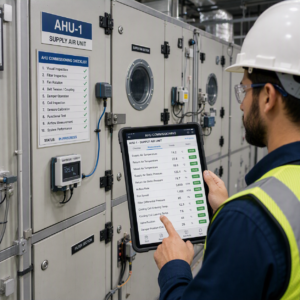
AHU commissioning
AHU commissioning ensures an air handling unit starts safely, meets design needs, and delivers the right airflow, temperature, humidity, and indoor air quality; eAuditor Audits & Inspections helps teams record each check, issue, and action.
A new AHU may look ready when the installation is complete. However, installation alone does not prove that the unit will perform as designed. AHU commissioning closes that gap. It checks the unit, connected systems, controls, airflow, safety features, and documents before the system moves into normal operation.
Good AHU commissioning also gives facility teams a clear record of what was tested and what still needs attention. With a digital inspection process, teams can capture results on site, add photos, assign corrective actions, and create reports without relying on scattered paper forms or spreadsheets. eAuditor supports digital checklists, mobile inspections, issue capture, actions, and reporting in one platform.
What is AHU commissioning?
AHU commissioning is the process of checking and testing an air handling unit to confirm that it works as intended and meets the project requirements.
An air handling unit can include several parts:
- Supply and return fans
- Filters
- Heating and cooling coils
- Dampers
- Humidifiers or dehumidifiers
- Mixing boxes
- Sensors
- Variable frequency drives
- Control panels
- Drain pans
- Condensate drains
- Duct connections
- Building management system controls
Commissioning brings these parts together as one working system.
The process should begin before the first start-up. Teams should review design documents, equipment data, installation quality, control sequences, testing requirements, and operating procedures. This approach helps identify problems early, when they are easier and cheaper to fix.
Why is AHU commissioning important?
An AHU affects more than room temperature. It can influence indoor air quality, energy use, occupant comfort, equipment life, and building performance.
A poorly commissioned AHU may create:
- Low or uneven airflow
- Poor temperature control
- High energy use
- Excessive noise or vibration
- Dirty or overloaded filters
- Condensate leaks
- Incorrect damper operation
- Control system faults
- Poor ventilation
- Unstable humidity
- Repeated equipment failures
Commissioning helps uncover these problems before they become routine operating issues.
It also creates a baseline. Facility teams can use the recorded results later when they troubleshoot faults or compare performance during maintenance.
AHU commissioning vs. AHU inspection
AHU commissioning and routine inspection serve different purposes.
An inspection checks the current condition of the equipment. Commissioning goes further by verifying that the system performs against defined requirements.
For example, an inspection may confirm that a filter is installed correctly. Commissioning can also verify airflow, pressure, fan operation, control response, and system performance.
Therefore, commissioning should not replace planned maintenance. Instead, it should provide a strong starting point for ongoing maintenance and performance checks.
Key stages of AHU commissioning
A structured AHU commissioning process makes the work easier to manage. Teams can divide the process into clear stages.
1. Review the project documents
Start with the design and project requirements.
Review:
- Approved drawings
- Equipment schedules
- Manufacturer manuals
- Design airflow values
- Temperature requirements
- Pressure requirements
- Control sequences
- Electrical details
- BMS points
- Testing and balancing requirements
- Maintenance instructions
- Safety requirements
The team should confirm that the installed AHU matches the approved design.
The eAuditor Project Commissioning Checklist is useful at this stage. It covers design and construction document reviews, equipment submittals, start-up procedures, staff training, maintenance documentation, system performance, and functional testing readiness.
Project Commissioning Checklist – eAuditor Template
2. Check the AHU installation
Next, inspect the physical installation.
Check that:
- The AHU sits securely on its base.
- Access panels are fitted correctly.
- Fans are installed correctly.
- Motors are secure.
- Flexible connections are in good condition.
- Duct connections are sealed.
- Dampers move freely.
- Filters are installed correctly.
- Coils are clean and accessible.
- Drain pans are clean.
- Condensate drains have suitable fall.
- Pipework connections are secure.
- Insulation is complete.
- Labels are clear and correct.
Small installation faults can create large operating problems. A loose connection, blocked drain, poor seal, or badly aligned fan can affect performance from day one.
3. Verify electrical systems
Electrical checks should happen before the AHU runs under normal conditions.
Verify:
- Correct power supply
- Correct cable connections
- Proper earthing
- Motor protection
- Isolator operation
- Control panel condition
- Emergency stops
- VFD settings
- Motor rotation
- Electrical labels
- Safe access to electrical equipment
The Electrical Commissioning Checklist in the eAuditor library can support this part of the process. It covers safe access, ventilation, lighting, labels, warning notices, switchgear, circuit identification, and other electrical commissioning checks.
Electrical Commissioning Checklist – eAuditor Template
4. Check fans and airflow
Airflow sits at the heart of AHU performance.
Commissioning teams should verify:
- Fan direction
- Fan speed
- Motor operation
- VFD response
- Supply airflow
- Return airflow
- Fresh-air airflow
- Exhaust airflow
- Static pressure
- Filter pressure drop
- Damper position
- Air balance
Testing and balancing should follow the approved project requirements and applicable standards.
Record actual readings instead of simply marking a test as complete. A measured value gives the team a useful baseline for future maintenance.
5. Test heating and cooling coils
Coils must provide the required heating or cooling capacity.
Check:
- Coil condition
- Pipe connections
- Valve operation
- Water flow where applicable
- Entering and leaving temperatures
- Control valve response
- Coil pressure drop where required
- Insulation
- Condensate drainage
- Frost protection where applicable
The team should also check whether the controls respond correctly when the required temperature changes.
6. Test filters and air cleanliness
Filters protect the AHU and help maintain indoor air quality.
Confirm:
- Correct filter type
- Correct filter size
- Proper installation
- No visible gaps
- Clean filter media
- Correct airflow direction
- Differential pressure monitoring
- Filter alarm operation
A filter that looks fine may still create a problem if it has the wrong rating or does not fit the frame properly.
7. Verify dampers
Dampers control how air moves through the system.
Test:
- Fresh-air dampers
- Return-air dampers
- Exhaust dampers
- Mixing dampers
- Fire and smoke damper interfaces where applicable
- Actuator operation
- Damper position feedback
The commissioning team should compare actual damper movement with the control sequence.
8. Test sensors and controls
Modern AHUs depend heavily on sensors and automation.
Check:
- Temperature sensors
- Humidity sensors
- Pressure sensors
- Airflow sensors
- CO₂ sensors where used
- Filter pressure sensors
- Freeze protection
- High-temperature alarms
- Fan status
- Damper feedback
- Valve feedback
Then test the control sequence.
For example, if the supply-air temperature moves outside the set range, the system should respond as designed. Likewise, a fan failure should create the correct alarm and trigger the correct response.
9. Test BMS integration
Where the AHU connects to a building management system, verify every required point.
Check:
- Start and stop commands
- Fan status
- Fault signals
- Temperature readings
- Pressure readings
- Humidity readings
- Damper positions
- Valve positions
- Alarm signals
- Setpoints
- Schedules
- Trend data
Do not assume that a displayed value is correct simply because it appears on the BMS screen. Compare selected BMS readings with field measurements during commissioning.
10. Perform functional performance tests
Functional testing shows how the AHU behaves under different operating conditions.
The team may test:
- Normal start-up
- Normal shutdown
- Occupied mode
- Unoccupied mode
- High-temperature conditions
- Low-temperature conditions
- Fan failure
- Sensor failure
- Filter alarm
- Emergency stop
- Fire alarm interface
- Loss of power
- BMS communication failure
Each test should have a defined expected result.
If the actual response differs, record the issue and assign it to the responsible person.
11. Record defects and corrective actions
Commissioning rarely ends with a perfect first test.
That is normal.
The important point is to manage every issue clearly.
Record:
- What failed
- Where it failed
- The evidence
- The person responsible
- Required action
- Target completion date
- Retest result
- Final status
eAuditor supports issue capture and corrective actions as part of its inspection workflow. Teams can capture findings in the field, assign tasks, and track them instead of keeping separate action lists.
12. Complete handover
The final stage is handover.
The team should confirm that the owner or facility operator receives:
- Approved drawings
- As-built drawings
- Equipment manuals
- Test results
- Commissioning records
- BMS information
- Setpoint information
- Maintenance schedules
- Warranty details
- Training records
- Outstanding issue records
- Final acceptance documents
The Construction Project Handover Checklist from the eAuditor library can support this stage. It includes mechanical services checks, confirmation that mechanical ventilation and air-conditioning plants operate, BMS checks, labels, service contracts, plant schedules, and test certificates.
Construction Project Handover Checklist – eAuditor Template
Useful eAuditor checklists for AHU commissioning
AHU commissioning involves several systems, so one checklist may not cover every requirement.
The following eAuditor templates can help build a more complete commissioning workflow:
Project Commissioning Checklist: Use it for project requirements, design reviews, equipment submittals, start-up procedures, training, maintenance documents, and functional testing readiness.
Project Commissioning Checklist
Equipment Commissioning Checklist: Use it for equipment documentation, licensing and testing, manuals, safe work procedures, modifications, and maintenance planning.
Equipment Commissioning Checklist
Electrical Commissioning Checklist: Use it to support checks for electrical facilities, safe access, ventilation, labels, warning notices, switchgear, circuits, and related electrical requirements.
Electrical Commissioning Checklist
Construction Project Handover Checklist: Use it when the AHU forms part of a wider building handover. It includes mechanical ventilation and air-conditioning plant checks, BMS checks, plant schedules, and test certificates.
Construction Project Handover Checklist
These templates can also serve as starting points. Teams can adapt digital forms to match their AHU type, project requirements, site conditions, and internal procedures.
How eAuditor supports AHU commissioning
Paper forms can make commissioning slow. They can also make follow-up harder.
With eAuditor, teams can build or adapt digital checklists, complete inspections on mobile devices, capture evidence, generate reports, and manage corrective actions. The platform also supports scheduling and recurring inspections, which can help teams move from one-time commissioning to ongoing equipment checks.
A practical AHU commissioning workflow could look like this:
- Create the commissioning checklist.
- Assign it to the commissioning engineer or technician.
- Complete installation checks on site.
- Record measured values.
- Attach photos and supporting evidence.
- Flag failed items.
- Assign corrective actions.
- Retest completed work.
- Generate the commissioning report.
- Store the final record for future reference.
This approach gives project managers, facility teams, contractors, and clients a shared view of progress.
eAuditor also provides inspection reporting features that allow teams to generate professional reports, customize report content, and keep completed inspection records in one place.
eAuditor Audits & Inspections
AHU commissioning checklist: a practical field list
A simple AHU commissioning checklist can include the following areas:
Documentation
- Approved drawings available
- Equipment data verified
- Manufacturer manuals available
- Control sequence available
- Test requirements confirmed
Installation
- AHU securely installed
- Ducts connected correctly
- Insulation complete
- Access panels secure
- Filters installed
- Coils clean
- Drainage complete
Mechanical
- Fans rotate correctly
- Motors operate correctly
- Belts or couplings checked
- Dampers operate correctly
- Valves operate correctly
- Vibration is acceptable
Electrical
- Power supply verified
- Earthing checked
- Protection devices checked
- VFD settings verified
- Emergency stop tested
- Electrical labels installed
Airflow
- Supply airflow measured
- Return airflow measured
- Fresh-air airflow measured
- Static pressure recorded
- Filter pressure drop recorded
- Air balance completed
Controls
- Sensors checked
- Setpoints verified
- Alarms tested
- Interlocks tested
- BMS points checked
- Control sequences tested
Handover
- Test results complete
- Defects closed
- Manuals handed over
- Training completed
- Maintenance plan provided
- Final report approved
Common AHU commissioning mistakes
Several problems appear again and again during commissioning.
Starting before installation checks are complete: This can expose equipment to avoidable faults.
Skipping measured readings: A simple pass/fail result does not show actual system performance.
Ignoring controls: Mechanical performance may look good while the control sequence remains wrong.
Failing to test alarms: An alarm that has never been tested may not work when the team needs it.
Leaving defects open: A commissioning issue should have an owner and a clear close-out path.
Poor documentation: Missing records make future troubleshooting much harder.
Treating handover as an afterthought: The facility team needs usable documents, training, and baseline data after the commissioning team leaves.
Benefits of a well-run AHU commissioning process
Effective AHU commissioning can help organizations:
- Improve system reliability
- Reduce avoidable downtime
- Improve occupant comfort
- Support indoor air quality
- Control energy use
- Reduce repeat faults
- Improve maintenance planning
- Create clear accountability
- Support project handover
- Build a useful performance baseline
Most importantly, commissioning changes the question from “Was the AHU installed?” to “Does the AHU actually work as required?”
That is the real value of AHU commissioning.
Frequently asked questions about AHU commissioning
What is AHU commissioning?
AHU commissioning is the process of verifying that an air handling unit and its connected systems operate safely and meet the required design and performance criteria.
When should AHU commissioning start?
Commissioning should start during the planning and design stages, not only after installation. Early review helps teams identify design, documentation, installation, and testing issues before they become costly problems.
What should AHU commissioning include?
It should normally include document review, installation checks, electrical checks, mechanical checks, airflow measurements, control testing, sensor verification, BMS testing, functional performance tests, defect close-out, and handover.
Who performs AHU commissioning?
A qualified commissioning engineer or competent HVAC professional should lead the work. The project may also involve HVAC contractors, controls specialists, electrical technicians, facility staff, and the equipment manufacturer.
Why should teams record actual readings?
Actual readings create a performance baseline. Teams can compare future results against that baseline and spot changes before they lead to larger faults.
Can digital checklists support AHU commissioning?
Yes. Digital checklists can help teams standardize checks, capture evidence, record measurements, assign actions, and produce reports. eAuditor supports these inspection and corrective-action workflows.
Can eAuditor templates be adapted for AHU commissioning?
Yes. The eAuditor template library includes commissioning, equipment, electrical, mechanical, and handover templates that can provide a useful starting point. Teams can adapt their inspection workflow to suit their project and operational needs.
Is AHU commissioning the same as maintenance?
No. Commissioning verifies system performance and establishes a baseline. Maintenance keeps the system operating over time. Both processes work together to support reliable AHU performance.
What happens after AHU commissioning?
The team should close outstanding defects, complete final testing, hand over documents, train operators, and establish a maintenance and inspection plan. The commissioning record then becomes a useful reference for future operation and troubleshooting. https://eauditor.app/2026/09/08/https-methodstatementhq-com-method-statement-testing-commissioning-air-handling-units-ahu-fahu-html/


Comments
Post a Comment